




Jacob Funnell
Just because someone has been writing documents for years, that doesn’t mean they’re doing it well.
I wish it were that simple. The fact is that many people succeed despite their writing, not because of it. As we said in this recent post, that’s why your standard shouldn’t only be to write like everyone else does.
Good writing is simply writing that has the effect you want on your reader or readers. So that should be your standard.
That effect might be that they take action (if you’re recommending a change, for example). Or it might be that they award your company a contract after reading the bid that you’re writing. Or it might just be making them a little happier, if you’re writing a thank-you email.
Dare to be different
Unfortunately, most people do just write like everyone else in their organisation (or sector). So writing more effectively than the norm can sometimes feel like ploughing a lonely furrow. It doesn’t help that there are numerous misconceptions about what does and does not make good writing.
Have confidence in trying new things
You can break free of these myths by exposing yourself to new, external influences.
For example, on this blog you can learn about making your writing more active or improving your sentence structure. Or you can download our free guide to better writing. All of these sources will give you a crucial outside perspective that you won’t get if you look only within your organisation or to much of the received wisdom on what is (or isn’t) right.
Before long, you’ll start to get a sense that some of the writing you read and receive could be improved. And more than that: you’ll get ideas about what to do about it.
[Want more ways to make sure your writing stands out from the crowd? Try Emphasis 360, our online business-writing training: short, interactive lessons to help transform everything you write at work. Try a lesson for free here.]
Pushback
Being different and trying new things isn’t always easy. Perhaps your manager or colleagues insist that you need to write in the passive voice for technical reports. Or maybe phoning instead of emailing about emotive subjects is frowned upon, because the phone is ‘only for emergencies’.
If that’s the case, you could try to change anyway, but make the changes less radical than you might. After all, evolution is sometimes more effective than revolution, so you could aim just for small victories.
For example, perhaps you’d like to use the active voice in technical reports (‘we did something’, rather than ‘something was done’), but your colleagues feel it’s a step too far. (Although even top scientific journals recommend this.) If so, try simply replacing people with things – so the thing becomes the ‘doer’. For example, ‘these results show’ rather than, ‘as shown by these results’. It’s still the active voice, but it’s less likely to ruffle anyone’s feathers.
Your colleagues may be reluctant to begin with, but then come to see that this actually improves the readability of your document. Sometimes your fear of doing something different is justified – but often it’s just a way of avoiding changing your ingrained writing habits.
Many avenues for improvement
However, if you really feel that you can’t make a particular change in the face of stubborn opposition, the next option is to try tackling another (perhaps less contentious) area.
We’ve identified at least fifteen ways to improve writing. Improving any of them can have enormous benefits, from increasing your clarity to making your writing much more persuasive.
So even if you are tied to using emails when the phone would be better, you can still learn more about how to write your email so you get better responses.
Or, if nobody in your organisation uses boxes to highlight important information in a report, you can make your documents far more interesting by using them. And if you break the trend of using long words needlessly, your ideas will stand out from the piles of verbose documents surrounding you.
Be confident
We’re not denying it: trying new things is hard. Doing it takes a fair amount of confidence (even courage). But it can pay dividends.
And above all, your readers will probably thank you for breaking the mould and daring to be different.
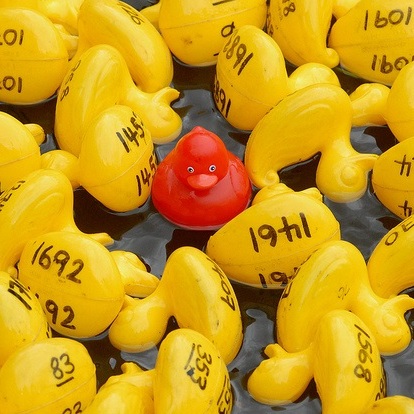
Image credit: Dare to be different – duck race by Harry (Howard) Potts used under CC BY 2.0 / cropped from original
Subscribe
Expert advice to your inbox